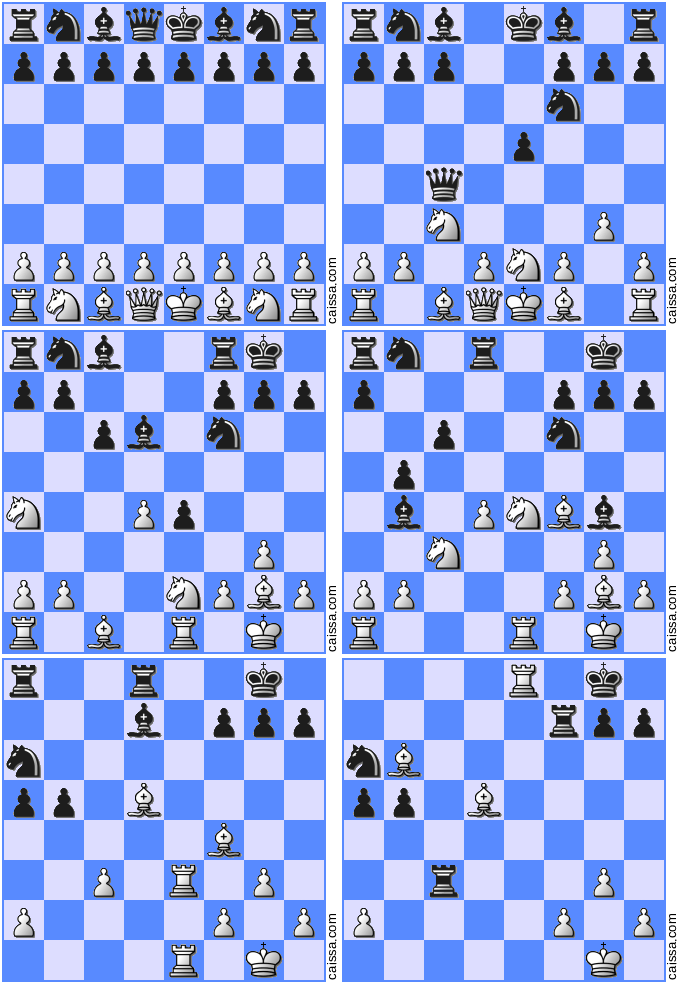
I just played another interesting game as black today.
White opened up with:
1. e4 e6
e6 has been my standard defensive reply as black. I usually follow up with a queenside fianchetto. It's not necessarily the strongest response, but I've found it to be very flexible as it's conservative with the pawn structure, and opens lines for development. I like having the queenside fianchetto with that bishop bearing down on the kingside. However, white surprised me by pushing the pawn early with:
2. e5...
Now I haven't studied the Scandanavian Opening in much depth, but this did seem to offer a similar opportunity, but I thought I would sneak in an extra attack first.
2. ... Nc6
3. d4 d6
4. Nf3 dxe5
White declined my pawn by developing his knight to add an extra defender, so I scooped up the pawn. His defending pawn was pinned to his queen - meaning that if he used it I could exchange queens and force him to lose castling rights.
5. Nxe5 Qxd4
He took the pawn back and I scooped up another one - my queen defended by my knight.
6. Nxc6 Qe4+
7. Be3 Qxc6
I could have taken his queen, but saw that I could get a free knight with a double attack.
8. Nc3 Bb4
He brought out his knight which allowed me to pin it to the king with my bishop. I don't like parting with my bishops, but the exchange (bishop-knight) is equal value plus I get to wreck his pawn structure.
9. Qd3 Nf6
10. a3 BxC3+
11. bxc3 O-O
I wasn't sure what he was up to bringing his queen out, so I figured I should get ready to castle. They often say to "castle early, castle often", but I've found that there tends to be an optimal time that comes at a critical point in the game to make that decision. He tried to kick my bishop with his a-pawn, so I took the knight and doubled his pawns.
12. f3 Nd5
13. Bd4 e5
14. Bxe5 Re8
White started his advance on the kingside. I didn't have strong move in mind, so I figured I would move my knight to the centre laying down some pressure. He moved his bishop which gave me an interesting opportunity. I advanced my e-pawn attacking it - offering it up for him to take which allowed me to pin his bishop with my rook.
15. f4 Nxf4
16. Qd4 Nxg2+
17. Bxg2 Qxg2
He made a mistake by advancing his f-pawn to protect the bishop and left it hanging for my knight to take. My knight then leapt to the attack to devastate the kingside structure. I lost it to the bishop but my queen had his back. White was left with a wreaked pawn structure and exposed king.
18. Rg1 Rxe5+
19. Qxe5 Qxg1+
He was hoping to take my queen, but by taking his bishop I put him in check forcing him to take with his queen off the same diagonal as his rook allowing me to take it.
20. Kd2 Qf2+
21. Qe2 Qf4+
22. Ke1 Bh3
I was close to getting licked. I had to put him in check and keep the initiative as he had a possible bank rank mater brewing on me. After a little dancing and getting my queen safe I could bring out my bishop - freeing my rook and blocking a potential escape square or two for the king.
23. Rb1 Qh4+
24. Kd2 Qg5+
25. Ke1 Qg1+
26. Kd2 Rd8+
He made a useless move with his rook. It would have been better to bring it up to his king for protection. I danced around a little more and pushed him into a skewer of the rook through the king. I was just about to take it, but noticed that I could bring my rook out which would force an exchange of that rook for his queen first. At this point he resigned.
This was definitely a stressful game. He made a couple of mistakes, I was able to use them to my advantage. I think in part that I got lucky that I didn't miss anything too significant. I definitely feel much more comfortable playing the quieter games, but this certainly was exciting!
Tuesday, 5 April 2011
Saturday, 2 April 2011
Danger of the Queen Raid
I just played at game this morning (as white) on yahoo against an opponent rated at 1360. I think it was interesting in how it demonstrates the dangers of developing the queen too early. My opponent was trying to play aggressively by bringing his queen out earlier than typical which left it open to being chased around and exchanged off the board...
1. c4 e5
2. e3 Nf6
3. g3 d5
4. Nc3 d4
5. exd4 Qxd4
I started with the English Opening. My first three moves were pawn moves that opened up lines for development and left me in a flexible position. He then made a bid for the center with a push of the d-pawn. I scooped it up after a developing move and wasn't expecting him to take it back with his queen.
6. Nge2 Qxc4
7. Bg2 Bc5
8. Qa4+ Qxa4
9. Nxa4 Bd6
10. O-O O-O
I obliged him with chasing his queen around. Looking back I think 6. Nf3 would have been stronger by limiting the queen more, but at the time I had an interest in controlling f4 and d4. I then fianchetto'd to gain a stronger hold on the center before forcing an exchange of the queens. I wasn't too concerned about losing mine in the exchange if it was a piece that he favoured heavily. At the end of the exchange, I feel that I was in a better position development-wise - his queenside is pretty much inactive and his bishops aren't on the best diagonals.
11. d4 c6
12. Re1 e4
13. Bf4 Bb4
14. Red1 Re8
15. Nec3 b5
I then made a push for center occupation with the d-pawn, defended by my knight on Ne2. I then slid my rook behind my knight (for defense and possible discovered attack later) and got my bishop out on the f4 square. He went after my rook with his bishop... I should have seen that coming, but I managed to interpose my knight which was defended. I'm good with losing a knight for a bishop when things are starting to open up.
16. Nc5 Bg4
17. Re1 Rd8
18. N5xe4 Bxc3
19. bxc3 Nxe4
20. Bxe4 Bd7
He was attacking my knight with his b-pawn, but made a great little outpost for me to jump to. He attacked my rook with his bishop, forcing me to move it and then he eyed his rook down on my d-pawn. I wasn't too concerend - I took out his central e-pawn with my outposted knight. He couldn't take the square back without loosing that knight, and he took my other knight with his bishop. Good with me - as I said I like bishops for knights as things are opening up, and he was looking to remove a defender of e4. He took it with his knight, but my fianchetto'd bishop nailed him.
21. Re3 a5
22. Rae1 Na6
23. d5 cxd5
24. Bxd5 Ra7
25. Re7 Rf8
I then made a rook lift so that I could later double up on them. He was trying something on the flank. I then pushed my d-pawn up more attacking his c-pawn and opening things up for the bishop pair to spear his rook if I got a chance. I then parked my rook on the 7th... always a good place to sit.
26. Be3 Rc7
27. Bb6 Rcc8
28. Rxd7 Rxc3
29. Rxf7 Rxf7
30. Re8#
I then chased his rook with my bishops to get him to move to the back rank so I could take his bishop. When his rook took c3, it was game over!
1. c4 e5
2. e3 Nf6
3. g3 d5
4. Nc3 d4
5. exd4 Qxd4
I started with the English Opening. My first three moves were pawn moves that opened up lines for development and left me in a flexible position. He then made a bid for the center with a push of the d-pawn. I scooped it up after a developing move and wasn't expecting him to take it back with his queen.
6. Nge2 Qxc4
7. Bg2 Bc5
8. Qa4+ Qxa4
9. Nxa4 Bd6
10. O-O O-O
I obliged him with chasing his queen around. Looking back I think 6. Nf3 would have been stronger by limiting the queen more, but at the time I had an interest in controlling f4 and d4. I then fianchetto'd to gain a stronger hold on the center before forcing an exchange of the queens. I wasn't too concerned about losing mine in the exchange if it was a piece that he favoured heavily. At the end of the exchange, I feel that I was in a better position development-wise - his queenside is pretty much inactive and his bishops aren't on the best diagonals.
11. d4 c6
12. Re1 e4
13. Bf4 Bb4
14. Red1 Re8
15. Nec3 b5
I then made a push for center occupation with the d-pawn, defended by my knight on Ne2. I then slid my rook behind my knight (for defense and possible discovered attack later) and got my bishop out on the f4 square. He went after my rook with his bishop... I should have seen that coming, but I managed to interpose my knight which was defended. I'm good with losing a knight for a bishop when things are starting to open up.
16. Nc5 Bg4
17. Re1 Rd8
18. N5xe4 Bxc3
19. bxc3 Nxe4
20. Bxe4 Bd7
He was attacking my knight with his b-pawn, but made a great little outpost for me to jump to. He attacked my rook with his bishop, forcing me to move it and then he eyed his rook down on my d-pawn. I wasn't too concerend - I took out his central e-pawn with my outposted knight. He couldn't take the square back without loosing that knight, and he took my other knight with his bishop. Good with me - as I said I like bishops for knights as things are opening up, and he was looking to remove a defender of e4. He took it with his knight, but my fianchetto'd bishop nailed him.
21. Re3 a5
22. Rae1 Na6
23. d5 cxd5
24. Bxd5 Ra7
25. Re7 Rf8
I then made a rook lift so that I could later double up on them. He was trying something on the flank. I then pushed my d-pawn up more attacking his c-pawn and opening things up for the bishop pair to spear his rook if I got a chance. I then parked my rook on the 7th... always a good place to sit.
26. Be3 Rc7
27. Bb6 Rcc8
28. Rxd7 Rxc3
29. Rxf7 Rxf7
30. Re8#
I then chased his rook with my bishops to get him to move to the back rank so I could take his bishop. When his rook took c3, it was game over!
Tuesday, 29 March 2011
SWOT: Evaluation and Analysis in Chess
The fundamental framework that I’m trying to develop for my thought process in chess is based on the SWOT methodology. SWOT analysis is a strategic planning method used to evaluate the Strengths, Weaknesses, Opportunities, and Threats involved to help with matching resources and capabilities to the competitive arena.
Strengths and Weaknesses would be those found within your own formation, while Opportunities (opponent weaknesses) and Threats (opponent strengths) would be the inverse of those as applied to your opponent.
To evaluate both your and your opponent’s advantages it helps to break things down into a few simple categories to determine value:
King Safety: The most important aspect – you must keep your king safe while looking for opportunities to put your opponent’s in jeopardy.
Quantity: Referring the material advantage, but more importantly to the local superiority of forces to focus on offense/defense in a contested area.
Piece Mobility: The flexibility of a piece as determined by it’s capacity to move around, unobstructed, into a stable square that is not easily attacked. This is largely influenced by spatial control and direction. I find it helps to try to picture the pieces with vectors coming out displaying their options.
Piece Interaction: The role that a piece (or the pawn structure as a whole) plays that can be defined by the following interactions between pieces:
- Out of play or en prise
- Defending an allied piece
- Interposing or blocking an enemy piece from attacking an allied piece
- Limiting or restricting an allied piece’s movement
- Obstructing or blockading the movement of an opponent’s piece
- Attacking an opponent’s piece
- Combinations of more than one of the above
Initiative: The possibility to create immediate threats to pressure your opponent to reduce his options. This is largely determined by proper development and making economical moves.
Once can then derive a mental matrix to formulate a tactical action plan moving forward.
Strengths Weaknesses
Opportunities: S-O strategies W-O strategies
Threats: S-T strategies W-T strategies
S-O strategies: pursue opportunities that are a good fit to your strengths.
W-O strategies: overcome weaknesses to pursue opportunities and take advantage of your opponent’s weaknesses.
S-T strategies: identify ways to use your strengths to reduce vulnerability to threats.
W-T strategies: establish a defensive plan to prevent your weaknesses from being highly susceptible to external threats.
Of course, each time your opponent makes a move, you will want to perform this type of reconnaissance, particularly asking what has changed with his last move. It’s important to rank the items in terms of severity. When looking for candidate moves, you will want to execute that move in your head, looking at the post-move board (performing the same analysis again) to see if you have managed to increase your advantage over your opponent.
EXAMPLE:
The following is an example of the above principles (being used, and ignored) from an online game last week where I played as black. It's not a spectacular game filled with amazing tactics, but does serve to illustrate the basic principles.
The position was reached after:
- e4 e6 (standard opening, simple defensive development)
- 2Qf3 Nc6 (white makes an aggressive move bringing the queen out early, I continue with a developing move that will protect a queenside fianchetto and the a5 square if I castle on the queenside)
- c3 b6 (white pushes the c-pawn forward not opening up any lines, I set up for a queenside fianchetto)
- Na3 Bb7 (white brings his knight to the flank severely limiting it’s scope, I complete the fianchetto pressuring the kingside)
- d3 NF6 (white supports the e-pawn and opens a diagonal for his bishop, I make a simple developing move attacking the e-pawn and dominating the centre)
- NH3 d5 (white makes the same knight move to the other side looking to attack on the flanks, I push my d-pawn forward protected by the e-pawn, f-knight, queen, and indirectly the fianchetto’d bishop)
- e5 Nxe5 (white pushes the e-pawn attacking my knight, I capture for free with the other knight and attack his queen and d-pawn)
- Qf4… (white attacks my knight which is currently unsupported…)
It’s fairly obvious that white has made a few poor moves, while black has focused more on coordinating the pieces together. Looking at the SWOT matrix we can come up with the following, simplified analysis:
Strengths:
A number of pieces protected at least once
b-Bishop indirectly controls the long diagonal towards the kingside
Knights are well placed controlling the center
e-Knight is ready to launch an assault if supported
f-Bishop ready to develop
Pawn structure is solid
King is currently safe
Weaknesses:
g-pawn, h-Rook, e-Knight and b-Bishop are undefended
f7 pawn is defended only by the king
King is open to attack along the a4-e8 diagonal
Opportunities:
White’s knights are limited in scope
Both rooks are unprotected
The King is unprotected and somewhat open
Early Queen development could be a liability
Bishops are currently blocked by white’s own piece/pawn
Threats:
Queen is attacking the e-Knight
The items that stand out from the above list are that his King is open and unprotected, my Knight, which is under attack by the open Queen and undefended, is able to jump to an attack to force him to react, and my development is superior. I can use my Knight to attack his King and force him to react to that threat, gaining initiative but the problem is that, right now, that initiative does nothing for me. However, if I move my f1-Bishop, to d6, I can protect my knight, with a possible discovered attack on his Queen, and maintain the attack on his a-Knight. His best option after will be to move the Queen to a4 (another wasteful Queen move without fully developed forces) to check my King, but I can easily interpose a protected piece in front of the line of attack.
So, I follow up with:
- … Bd6
- NG5 Nxd3+ (white didn’t see the threats of my move and moved his Knight into my territory, I take his d-pawn and fork his King and Bishop)
- Bxd3 Bxf4 (White’s only viable option is to take my knight with his Bishop, I get to take his Queen)
Of course, on the next move white took my Bishop with his c-Bishop, but I won a Queen and a pawn for a Knight and a Bishop and white is left with rather limited mobility and piece quality (while I’m ready to advance my d-pawn and spear his h-rook if he doesn’t pay attention).
As was fairly obvious, white made some poor moves that, while attacking, limited his scope of action while endangering his safety. He was moving, intent on forcing his strategy to work, without letting the board tell him where his pieces needed to go.
As demonstrated, a simple, logical thought process based on sound evaluation and analysis can only benefit your game!
Monday, 28 March 2011
Great Game Saturday Night!
Saturday night my brother had a "games-night" get together. I went, along with my wife, and we had a pretty good time. We spent most of the evening socializing (with no games being played) but I noticed he had a chess board and asked if anyone wanted to play.
My brother volunteered his friend Dale (very intelligent and into strategy games), so we broke it out and played. My brother was quite adamant that I was going to be crushed as Dale has been playing for a while recreationally.
I gotta say this was one of the most enjoyable games that I've played. We seemed to be both around the same skill level. I've noticed when playing online that my opponents have been either playing very unsound moves (eg the queen-rush) or been incredibly strong, with no in-between.
I played as black. Dale opened up with e4 and I replied with e3 (somewhat passive but retains pawn integrity while allowing for development and more positional play). My thoughts were to try and get him to over extend his pawn center and to maneuver around and counterattack. He then moved Nf3 and I replied with Nf6. He pushed his pawn (extending further) and I had to carefully dance around a bit, loosing tempo. Some of you may recognise this as being similar to Alekhine's Defence (modern variation).
I then set up a queenside fianchetto - putting pressure on the kingside. I was able to spear his rook early in the game. He worked on occupying the centre, I worked on keeping a tight pawn structure and setting up around the flanks, particularly on the queenside. I managed to force his king to move with one of my knights, which I then lost shortly after, but he lost his castling rights and his only choice was to move the king to the kingside for protection if he didn't want to block his remaining rook. I castled over on the queenside as his pieces were gearing up for a kingside attack. I know that castling on the opposite side into a fianchetto is not preferred, but I felt that I would gain some time as he'd have to redirect his pieces.
My brother and one of his friends checked in and exclaimed that Dale was winning as he occupied the centre. Dale then explained to them how it's more about controlling the center and piece mobility/coordination.
Things then explosively opened up in the center. He got his queen into the action busting up my pawn formation in my fianchetto. By the end of that battle he had taken both my knights and 5 pawns, but at the cost of his bishops and a pawn. I had to bring my king up to the center of the second rank (blocking/protected by one of his pawns). I managed to chase his queen back with my queen and a bishop and then trapped her pinning against the king, forcing him to exchange queens (mine protected by a rook). Material was fairly even - I had taken a couple pawns, both bishops, a rook, and queen; he had taken 5 pawns, both knights, and my queen. Technically I was two pawns ahead in 'material count'.
We maneuvered a little bit more - I started bringing the king into the attack, and then, of all things... I managed for fork his two knights with my king! For some reason I find that the closer to the endgame I get, the better I play. At that point is was getting late and Dale offered his resignation as he would lose a knight and his remaining rook never got a chance to get out as it was being used for defense. I told him we could just call it a draw as it could have gone either way.
Looking back in retrospect - we should have recorded our moves so I could throw it into a chess engine to see what it suggests. I'm just using a freeware chess game (Mayura) that will show suggested moves.
Anyway, like I said it was a very enjoyable and creative game. I'm looking forward to the next one!
My brother volunteered his friend Dale (very intelligent and into strategy games), so we broke it out and played. My brother was quite adamant that I was going to be crushed as Dale has been playing for a while recreationally.
I gotta say this was one of the most enjoyable games that I've played. We seemed to be both around the same skill level. I've noticed when playing online that my opponents have been either playing very unsound moves (eg the queen-rush) or been incredibly strong, with no in-between.
I played as black. Dale opened up with e4 and I replied with e3 (somewhat passive but retains pawn integrity while allowing for development and more positional play). My thoughts were to try and get him to over extend his pawn center and to maneuver around and counterattack. He then moved Nf3 and I replied with Nf6. He pushed his pawn (extending further) and I had to carefully dance around a bit, loosing tempo. Some of you may recognise this as being similar to Alekhine's Defence (modern variation).
I then set up a queenside fianchetto - putting pressure on the kingside. I was able to spear his rook early in the game. He worked on occupying the centre, I worked on keeping a tight pawn structure and setting up around the flanks, particularly on the queenside. I managed to force his king to move with one of my knights, which I then lost shortly after, but he lost his castling rights and his only choice was to move the king to the kingside for protection if he didn't want to block his remaining rook. I castled over on the queenside as his pieces were gearing up for a kingside attack. I know that castling on the opposite side into a fianchetto is not preferred, but I felt that I would gain some time as he'd have to redirect his pieces.
My brother and one of his friends checked in and exclaimed that Dale was winning as he occupied the centre. Dale then explained to them how it's more about controlling the center and piece mobility/coordination.
Things then explosively opened up in the center. He got his queen into the action busting up my pawn formation in my fianchetto. By the end of that battle he had taken both my knights and 5 pawns, but at the cost of his bishops and a pawn. I had to bring my king up to the center of the second rank (blocking/protected by one of his pawns). I managed to chase his queen back with my queen and a bishop and then trapped her pinning against the king, forcing him to exchange queens (mine protected by a rook). Material was fairly even - I had taken a couple pawns, both bishops, a rook, and queen; he had taken 5 pawns, both knights, and my queen. Technically I was two pawns ahead in 'material count'.
We maneuvered a little bit more - I started bringing the king into the attack, and then, of all things... I managed for fork his two knights with my king! For some reason I find that the closer to the endgame I get, the better I play. At that point is was getting late and Dale offered his resignation as he would lose a knight and his remaining rook never got a chance to get out as it was being used for defense. I told him we could just call it a draw as it could have gone either way.
Looking back in retrospect - we should have recorded our moves so I could throw it into a chess engine to see what it suggests. I'm just using a freeware chess game (Mayura) that will show suggested moves.
Anyway, like I said it was a very enjoyable and creative game. I'm looking forward to the next one!
Saturday, 26 March 2011
Introduction
Hi Everyone,
Back towards the end of January, 2011 I discovered that I really enjoy the game of chess. I've known the rules ever since I was young, but never pursued it any further than that. I've now found that I enjoy the mental challenge and the associated depth of layered strategy and tactics.
As I have both a family and a demanding profession, I am somewhat limited with how much time I can devote to it. My aspirations are only to be a "strong recreational player". My focus will be on strategic and tactical themes - trying to find the best move because I understand the board, and as I work through developing that thought process, I will be posting about it. I don't expect to post anything revolutionary - it's intended to help my thought processes and for anyone who may be interested.
Back towards the end of January, 2011 I discovered that I really enjoy the game of chess. I've known the rules ever since I was young, but never pursued it any further than that. I've now found that I enjoy the mental challenge and the associated depth of layered strategy and tactics.
As I have both a family and a demanding profession, I am somewhat limited with how much time I can devote to it. My aspirations are only to be a "strong recreational player". My focus will be on strategic and tactical themes - trying to find the best move because I understand the board, and as I work through developing that thought process, I will be posting about it. I don't expect to post anything revolutionary - it's intended to help my thought processes and for anyone who may be interested.
Subscribe to:
Posts (Atom)